Introduction
Every June, the same scene plays out in lakhs of Indian households: a Class 12 student staring at an admission form, cursor blinking over a dropdown menu of engineering branches, completely stuck. CSE sounds exciting but “everyone’s doing it.” Mechanical feels solid but “is it still relevant?” AI & ML sounds like the future but “what does it even mean day-to-day?”
Here’s the truth: there’s no universally “best” branch — only the best branch for you. This guide breaks down every major B.Tech stream at DRIEMS University in plain language, so instead of guessing, you can actually decide.
The Quick-Look Comparison Table
| Branch | What you'll actually do | Best for students who... | Typical career paths |
|---|
Breaking the Biggest Myths That Confuse Students
“CSE is the only branch with good placements.”
Not true. Placement quality depends on skill-building and internships far more than the branch name. Mechanical and Civil graduates with strong practical exposure are recruited by core companies, PSUs, and infrastructure firms every year.
“AI & ML is just CSE with a fancier name.”
Partially true, partially not. AI & ML shares a CSE foundation but goes deeper into mathematics, statistics, and model-building — it suits students who enjoy data and pattern recognition specifically, not just coding in general.
“Core branches like Mechanical and Civil are ‘dying.”
They’re not dying — they’re evolving. Automation, smart manufacturing, and green infrastructure are actively reshaping these fields, not replacing them.
“Electrical and Electronics are basically the same.”
They overlap but aren’t identical. Electrical leans toward power systems and heavy machinery; Electronics leans toward circuits, signals, and communication systems.
A Simple 3-Question Self-Check
Before you shortlist a branch, ask yourself
Do I enjoy solving abstract problems on a screen, or do I enjoy building/fixing physical things?
Do I want a broad, flexible skill set or a deep, specialized one?
Am I choosing this branch because of genuine interest, or because "everyone says it's in demand"?
A Simple 3-Question Self-Check
The engineering branch that will serve you best isn’t the one topping this year’s salary charts — it’s the one that keeps you curious enough to actually build things, ask questions, and put in the extra hours during projects and internships. Every branch listed here at DRIEMS University has produced graduates who’ve gone on to strong careers, simply because they picked based on genuine interest and then worked at it.
If you’re still torn between two options, that’s completely normal — talk to DRIEMS’ academic counselors, current students, or alumni from those specific branches before locking in your choice.
Frequently Asked Questions
Placement outcomes depend more on individual skill-building, internships, and projects than on the branch alone. CSE and its specializations currently see high recruiter demand, but core branches like Mechanical and Civil also have strong placement records through PSUs and infrastructure companies.
Neither is "better" — they serve different interests. Regular CSE offers broader software development skills, while AI & ML goes deeper into data, statistics, and machine learning specifically.
Yes. These branches remain essential to manufacturing, construction, and infrastructure, and are evolving with automation and smart-technology integration rather than becoming obsolete.
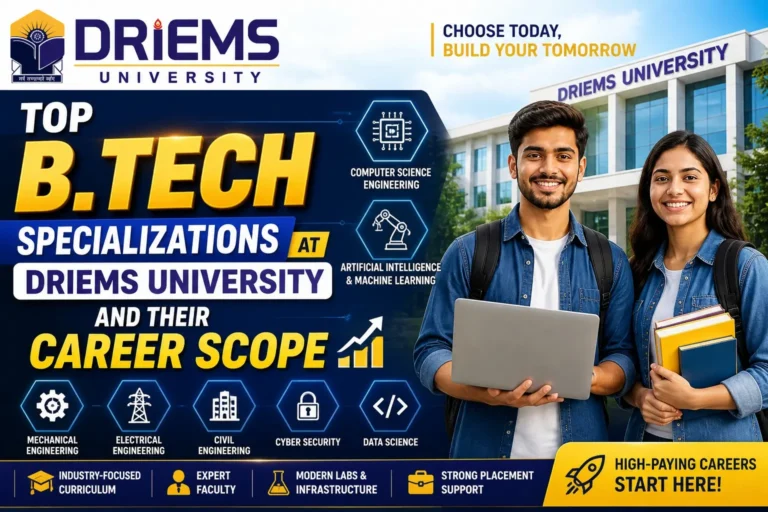
DRIEMS University offers a wide range of B.Tech branches including CSE and its specializations (AI & ML, Data Science, Cyber Security, IoT), Computer Science & IT, Electronics & Telecommunication, Electronics & Computer Engineering, Electrical Engineering, Electrical & Electronics Engineering, Mechanical Engineering, Mechanical & Automation Engineering, and Civil Engineering.
Most core engineering fundamentals (math, physics, problem-solving, programming basics) overlap across branches in the first year, and many skills are transferable. Talk to academic counselors early if you're unsure — switching or specializing later is often possible.